
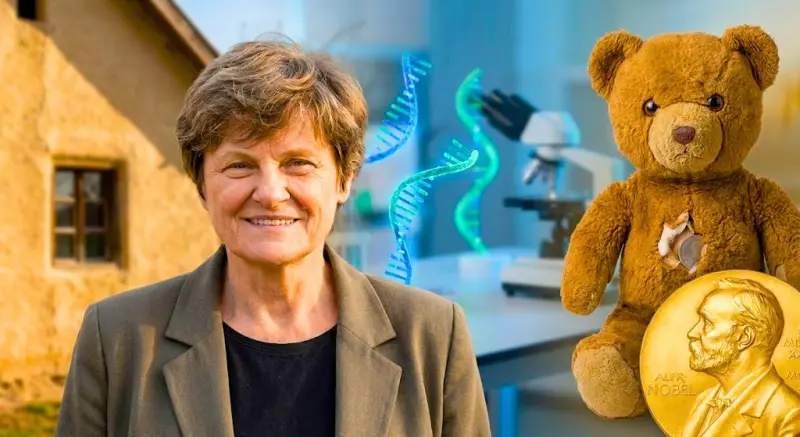
The year is 1995. You’re a scientist at a prestigious American university, but your career is hanging by a thread. Your groundbreaking ideas are dismissed as impractical, funding applications are routinely rejected, and your department is threatening demotion. To top it all off, you’ve just been diagnosed with breast cancer, and your husband is stranded in another country due to visa issues. This isn't a scene from a tragic movie; it's a snapshot of Katalin Karikó's life, a woman whose unwavering belief in a radical scientific concept would, less than three decades later, earn her a Nobel Prize and fundamentally change the course of medicine.
A Childhood Forged in Fire Under the Iron Curtain
Katalin Karikó’s journey began far from the hallowed halls of academia, in a small Hungarian village called Kisújszállás. Born in 1955, she grew up in an adobe house with no running water, refrigeration, or television, reliant on a wood-burning stove for brutal Hungarian winters [5]. Her father, a butcher, unwittingly provided her first biology lessons. Watching him work, the young Katalin was fascinated by animal anatomy, observing organs and muscles, sparking an early curiosity about the mechanisms of life [4].
Life under Soviet domination was harsh. Just a year after her birth, Hungary erupted in a revolution against Soviet influence. Karikó’s father participated, leading to professional repercussions and economic hardship for the family [4]. This early exposure to adversity taught Katalin resilience, a trait that would become her most potent weapon against the scientific establishment. Despite the impoverished rural setting, her sharp mind shone through. She excelled in science, even placing third in a national biology competition at just 14 years old [4]. Her path led her to the University of Szeged, where she earned her biology degree in 1978 and began her complex relationship with RNA research [4].
The Teddy Bear and the American Dream Deferred
After earning her Ph.D. in biochemistry in 1982, Karikó focused on synthesizing and modifying RNA at the Biological Research Center in Szeged [4]. But the political climate was suffocating. She later revealed that she was pressured by the Hungarian secret police to collaborate, facing threats to her career and family if she refused [4]. This period of clandestine surveillance further solidified her resolve to pursue science on her own terms.
By 1985, her lab faced severe funding cuts, and Karikó found herself without a job. Married to engineer Béla Francia, with a two-year-old daughter, Susan, she saw few opportunities in an increasingly restrictive Hungary. A postdoctoral fellowship offer from Temple University in Philadelphia was her ticket out [4]. But leaving was a challenge. Strict Hungarian laws prohibited taking foreign currency out of the country. Karikó and her husband sold their Lada car for about $1200—their entire savings. In a desperate, ingenious act, they carefully stitched the cash into their daughter Susan’s teddy bear. With the bear as their secret treasure, they crossed borders and began their new life in America, a literal "teddy bear full of money" [5].
The Academic Wall: A Decade of Rejection and Resilience
At Temple, Karikó dove into research involving double-stranded RNA for AIDS and blood disorders. She worked tirelessly, earning barely a dollar an hour, but her conviction grew: RNA held immense therapeutic potential if only it could be harnessed [1]. However, her relationship with her supervisor, Dr. Robert Suhadolnik, quickly soured. When she received a job offer from Johns Hopkins in 1988, he threatened to deport her, even contacting immigration authorities [4]. Karikó fought back, losing the Johns Hopkins offer but successfully transitioning to the University of Pennsylvania (UPenn) in 1989, starting a new chapter of struggle [4].
At UPenn, as an assistant research professor in cardiology, Karikó championed her bold idea: using messenger RNA (mRNA) to instruct cells to produce therapeutic proteins, offering a safer alternative to gene therapy [4]. Yet, the scientific community largely dismissed her. The main problems? mRNA was too unstable, quickly degraded by enzymes in the body, and it triggered a violent immune response, causing severe inflammation [3].
The year 1995 marked Karikó’s rock bottom. Repeated failures to secure grants led to a university ultimatum: "publish or perish." She was demoted from the tenure track, her salary slashed [15]. Simultaneously, she battled breast cancer and underwent surgery and treatments [4]. Alone, with her husband facing visa issues and her teenage daughter needing care, she felt isolated and inadequate. But her belief in mRNA never wavered. She chose to stay, accepting the demotion, working tirelessly in the lab, finding solace in her science [1].
The Copy Machine Revelation and the Silent Breakthrough
Then, in 1997, a chance encounter changed everything. At a university copier, Karikó met Drew Weissman, a new immunology professor from the NIH, who was researching an HIV vaccine [1]. Karikó offered her expertise in RNA synthesis, and a partnership was born.
They immediately faced the familiar problem: synthetic mRNA caused severe inflammation in immune cells, halting protein production. But Karikó, with her deep understanding of RNA chemistry, noticed something critical: natural RNA, like tRNA, didn't cause this reaction [3]. The hypothesis: natural RNA must have chemical modifications that shield it from the immune system.
After years of meticulous experimentation, they discovered that replacing one of mRNA's basic building blocks, uridine, with a naturally occurring modified version called pseudouridine, yielded astonishing results [3]:
- The immune system no longer recognized the modified mRNA as foreign, preventing inflammatory responses.
- Protein production dramatically increased, sometimes by 10 to 100 times, because the modification prevented enzymes from shutting down translation [17].
This was it – the breakthrough! They tried to publish in top journals like Nature and Science, but were rejected, deemed "incremental" [9]. Their pivotal 2005 paper, titled "Suppression of RNA Recognition by Toll-like Receptors: The Impact of Nucleoside Modification," eventually appeared in Immunity
[9]. Karikó expected an earthquake in the scientific world. Instead, there was a "deafening silence." No calls, no conference invitations [9].
To make matters worse, UPenn, which owned the intellectual property, sold the exclusive license for a paltry $300,000 to a small company called Cellscript [4]. This decision effectively sidelined Karikó and Weissman, delaying the widespread clinical application of their technology for years, until giants like Moderna and BioNTech finally took notice [4].
From Mockery to mRNA Messiah
By 2013, still struggling for recognition and denied a return to the tenure track at UPenn, Karikó made a radical choice. She accepted an offer from Uğur Şahin to become Senior Vice President at a tiny, unknown German startup called BioNTech [4]. Her colleagues scoffed, "BioNTech? They don't even have a website!" [4] Karikó left her family behind, moving to a small apartment in Germany to focus on developing mRNA therapies for cancer [4].
Then, in early 2020, the world changed. The SARS-CoV-2 virus unleashed a global pandemic. Karikó and Şahin immediately recognized their modified mRNA technology as the perfect solution for a rapid vaccine. BioNTech launched "Lightspeed" and partnered with Pfizer. Moderna, founded on similar mRNA research, also quickly developed a vaccine [2]. The clinical trials were astonishing, showing over 90% efficacy. By late 2020, the vaccines were rolling out globally, saving millions of lives and fundamentally altering the pandemic's trajectory [2].
The world finally acknowledged Katalin Karikó. A torrent of awards followed: the Lasker-DeBakey Clinical Medical Research Award (2021), the Princess of Asturias Award (2021), the Breakthrough Prize (2022), the Japan Prize (2022), and finally, in 2023, the Nobel Prize in Physiology or Medicine, shared with Drew Weissman [3]. From a demoted researcher to a Nobel laureate, her vindication was complete.
Beyond the Spotlight: A Future Forged in mRNA
Even in her late sixties (as of 2025), Katalin Karikó remains intensely active. As a professor at UPenn and a consultant for BioNTech, her current research extends mRNA applications beyond infectious diseases [8]. She's exploring intratumoral injections of mRNA to deliver immune-stimulating cytokines for cancer treatment, developing non-inflammatory mRNA for autoimmune diseases like multiple sclerosis, and pursuing older ideas of using mRNA to repair damaged heart tissue [8].
Her story of perseverance has inspired millions. Her memoir, "Breaking Through: My Life in Science," published in 2023-2024, became a bestseller [6]. In 2025, the Carnegie Corporation will release a comic book about her life, part of their "Great Immigrants" series, aiming to inspire young minds [10]. Her schedule is packed with global speaking engagements, sharing not just science, but powerful lessons on resilience in the face of failure [9].
Watch the Full Discussion
Sources & References
Key Sources
- Katalin Karikó - The Rockefeller University
- Karikó and Weissman win Nobel Prize for mRNA research - Penn Medicine
- The Nobel Prize in Physiology or Medicine 2023 - Advanced Information
- Katalin Karikó – Wikipedia
- Katalin Karikó, a teddy bear full of money and a Nobel Prize for a lifetime's work
- Breaking Through by Katalin Karikó - Porchlight Book
- Breaking Through - Austin Public Library | BiblioCommons
- Katalin Kariko, PhD - Penn Medicine
- Katalin Karikó - ESHG Conference 2025
- Great Immigrant: Katalin Karikó – Carnegie Corporation of New York
- Katalin Karikó: Distinguished Daughters of Pennsylvania
- Nobel Prize-winner Katalin Karikó lectures on campus - Office of the President
View Full Bibliography
- Kati Karikó | National Women's History Museum
- From “Not Good Enough” to Nobel Prize Winner - Yale Scientific Magazine
- She Was Demoted & Threatened with Deportation. Then She Won the Nobel Prize | Amanpour and Company - YouTube
- Could Today's Katalin Karikó Come to America? – Cato Institute
- Profile of Katalin Karikó and Drew Weissman: 2023 Nobel laureates in Physiology or Medicine | PNAS
- Katalin Karikó | epo.org
- Researcher demoted by university wins Nobel Prize - Juta MedicalBrief
- Press release: The Nobel Prize in Physiology or Medicine 2023 - NobelPrize.org
- Katalin Karikó: Breaking the Wall of Genetic Barriers | Science Summit 2025 - YouTube
- Katalin Karikó | National Inventors Hall of Fame®
- List of awards and honors received by Katalin Karikó – Wikipedia
- Katalin Karikó - Vilcek Foundation
- Dr. Katalin Karikó, Prof. Ugur Sahin and Prof. Özlem Türeci Honored with the Friends of the National Library of Medicine's 2024 Distinguished Medical Science Award
- Katalin KARIKÓ | Adjunct professor | PhD | University of Pennsylvania, Philadelphia | UP | Department of Neurosurgery | Research profile - ResearchGate
- Twenty Distinguished Naturalized Citizens Honored as Foundation Celebrates 20 Years of Great Immigrants, Great Americans Tribute | Carnegie Corporation of New York
- Katalin Karikó - Falling Walls
- The impossible takes longer - Event information - NobelPrize.org
- Nobel laureate Katalin Karikó at MedUni Vienna: "The Future of mRNA Therapy" - MedUni Wien
- From Overlooked to Nobel Laureate: Katalin Karikó's Journey - Baker Institute
- Interview With Katalin Karikó - Issues in Science and Technology
- Double Helix Medal recipient Dr. Katalin Karikó – Cold Spring Harbor 2024 Laboratory
Conclusion
Katalin Karikó’s extraordinary journey from a Hungarian village without running water to the Nobel stage in Stockholm is more than a personal success story. It’s a powerful critique of an academic system that often favors "safe" research over radical innovation, and a testament to the resilience of immigrant scientists. Her unrelenting belief in mRNA, even when others scoffed, not only ended a global pandemic but also unlocked a new era of personalized and genetic medicine. Karikó’s struggle wasn't just hers; it was an investment in the future health of humanity.