Imagine a world where a sitting president can be plucked from their palace by foreign powers. This isn't a spy novel; it's a chilling reality, dramatically highlighted by the supposed 2026 capture of Venezuela's Nicolás Maduro. This event isn't just an isolated military strike; it's the culmination of a long history of powerful nations, particularly the United States and France, dealing with leaders they deem 'rogue' or opposed to their interests. We're going to break down the dramatic 2026 operation and trace its lineage through decades of geopolitical shifts and legal maneuvers, from the Algerian Revolution to Panama, Haiti, and beyond.
The Shockwave: Maduro's 2026 Capture
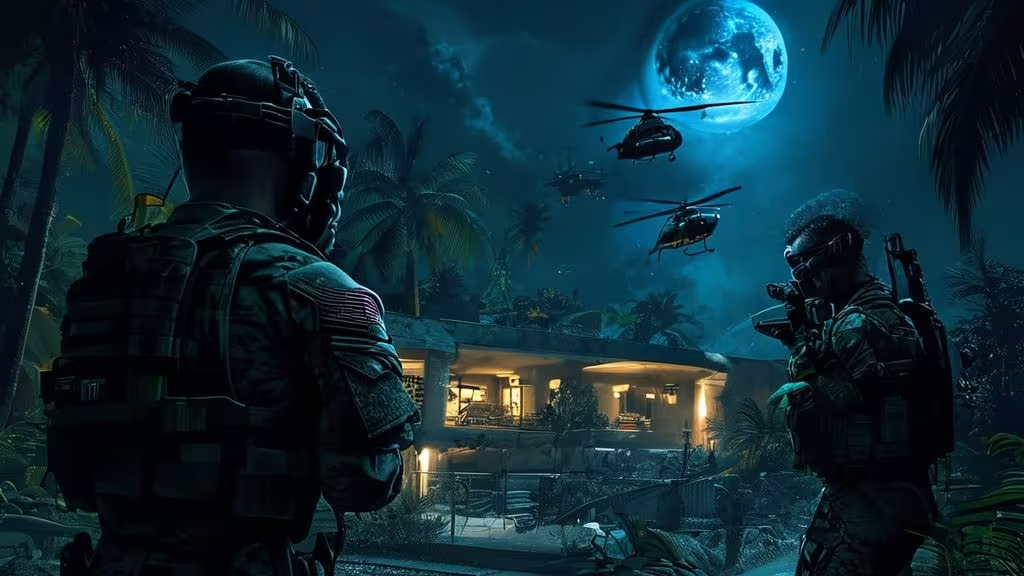
In the early hours of January 3, 2026, the world witnessed an unprecedented application of what some might call 'overwhelming force' fused with 'law enforcement' against a sovereign head of state. Intelligence reports and field data suggest that 'Operation Absolute Resolve' wasn't a snap decision but the result of months of meticulous planning. At 2:00 AM local Venezuelan time, the United States launched an intense air assault involving over 150 warplanes. This strike targeted air defense systems and military infrastructure in northern Venezuela, designed to cripple the Venezuelan army's ability to respond quickly.[1]
During the aerial bombardment, elite U.S. units, including Delta Force and the 160th Special Operations Aviation Regiment, executed an air assault deep into Caracas. Their precise target: the presidential compound where President Nicolás Maduro and his wife, Cilia Flores, were believed to be. Reports indicate that U.S. forces had trained on a replica of Maduro's bunker, which former President Donald Trump described as a 'heavily guarded fortress'.[1] The invading force faced fierce resistance from presidential guards and loyal security personnel, leading to the deaths of at least 23 Venezuelan and 32 Cuban security forces. The operation concluded with the arrest of President Maduro and his wife, who were immediately transported by helicopters to the amphibious assault ship USS Iwo Jima in the Caribbean, and then flown to an airbase in New York.[3]
The Narco-Terrorism Justification
The U.S. administration didn't frame this operation as a traditional 'declaration of war', but rather as an international 'law enforcement' action. The domestic legal basis for this move rested on federal indictments issued by the Southern District of New York, accusing Maduro of leading a 'narco-terrorism conspiracy'.[2] The indictment detailed Maduro's alleged alliance with criminal organizations like the 'Cartel of the Suns' and the 'Tren de Aragua' to flood the U.S. with cocaine, using proceeds to fund destabilizing activities. Attorney General Pamela Bondi affirmed that Maduro would face justice in American courts, citing extraterritorial jurisdiction in terrorism and drug cases.[5]
This approach highlights the 'Ker-Frisbie Doctrine', a legal precedent allowing U.S. courts jurisdiction over defendants brought to the U.S., even if unlawfully abducted. This doctrine was controversially applied to former Panamanian leader Manuel Noriega, and now, hypothetically, to Maduro.[15]
Venezuela's Response: A Nation Divided
In stark contrast to the swift collapse of the Panamanian regime in 1989, Venezuela's government showed institutional resilience. Vice President Delcy Rodríguez condemned the operation as a 'kidnapping' and a violation of the UN Charter. She immediately assumed the acting presidency, backed by the Supreme Court and military leaders who reaffirmed their loyalty to the 'abducted president' and the Bolivarian Constitution. Rodríguez dismissed U.S. claims that Washington would 'run' the country, asserting that Venezuela would not be a colony of any empire. This created a dangerous duality: a president imprisoned in New York claiming 'prisoner of war' status and clinging to legitimacy, while a government in Caracas maintained control on the ground, demanding his release. This situation could lead to a protracted conflict.[7]
The Noriega Blueprint: Panama's Invasion (1989)
The case of General Manuel Noriega serves as a crucial 'blueprint' for the U.S.'s strategy against Maduro. The similarities in justifications and mechanisms are striking, though the geopolitical context differs. For years, Noriega, Panama's de facto military leader, was a strategic ally of the CIA and DEA, used by Washington as a backchannel and a tool against communist influence in Central America. However, this relationship soured in the late 1980s as his deep involvement in facilitating Colombian Medellín Cartel operations, political assassinations, and electoral manipulation became undeniable.[10]
In 1988, U.S. grand juries in Florida indicted Noriega on drug trafficking and racketeering charges—the first time a foreign head of state was criminally indicted.[12] On December 20, 1989, after a U.S. soldier was killed in Panama and Noriega declared a state of war, President George H.W. Bush launched 'Operation Just Cause', a full-scale invasion involving 27,000 troops. The stated goals were to 'protect American lives', 'restore democracy', and 'capture Noriega to face indictment'.[14] Noriega sought asylum in the Vatican embassy, prompting a psychological siege by U.S. forces, who blasted loud rock music around the embassy (songs like Van Halen's 'Panama' and The Clash's 'I Fought the Law') to wear him down.[11]
Noriega surrendered on January 3, 1990 (interestingly, the same date as Maduro's hypothetical capture), and was flown to Miami in military uniform, classified as a 'prisoner of war' under the Geneva Conventions. Yet, this didn't prevent his criminal trial.[15] His defense argued he held 'head of state immunity', but the court rejected this, stating the U.S. did not recognize him as a legitimate head of state, but rather as a de facto leader of a rebellious army. He was sentenced to 40 years (serving 17 years in the U.S. before extradition to France and then Panama), solidifying the principle that U.S. courts can prosecute foreign leaders brought to American soil, regardless of how they arrived.[10]
"Soft Coups" & Crisis Abductions: Haiti (2004) & Honduras (2009)
Unlike the overt military invasions in Panama and Venezuela, the Caribbean region has seen another type of presidential removal, marked by ambiguity and direct involvement of ambassadors and intelligence operatives in the final moments—a process sometimes called 'forced removal'.
Jean-Bertrand Aristide (Haiti 2004): Protection or Kidnapping?
The departure of Haitian President Jean-Bertrand Aristide on February 29, 2004, remains one of the most debated cases. Aristide faced an armed rebellion led by former officers and supported by the political opposition, with rebels advancing on the capital, Port-au-Prince. In the early hours of his departure, U.S. security officials and diplomats arrived at Aristide's residence. The U.S. narrative claims Aristide requested assistance to leave to avoid a 'bloodbath', and the U.S. provided a plane to save his life and take him to a safe location.[19]
However, upon arrival in the Central African Republic, Aristide told media outlets he had been 'kidnapped'. He claimed U.S. forces threatened to 'open fire' if he didn't leave, and he was forced onto a plane without knowing its destination, surrounded by American guards who prevented him from contacting anyone.[17] Aristide lived in exile in South Africa for seven years, returning in 2011, confirming his departure was not a voluntary retirement but a forced removal. His supporters considered what happened a coup orchestrated by Western powers (France and the U.S.) to remove a popular leader demanding reparations for colonialism.[23]
Manuel Zelaya (Honduras 2009): The "Pajama Coup"
In Honduras, the military was the direct executor, but the operation was backed by a suspicious political and international silence initially. On June 28, 2009, army soldiers stormed President Manuel Zelaya's residence, abducting him in his pajamas at gunpoint and flying him to an airbase, from which he was exiled to Costa Rica.[24] Zelaya was accused of attempting to amend the constitution to extend his term through a public referendum, which the Supreme Court and military deemed treason.[24]
Despite the Obama administration's later condemnation of the coup, the plane carrying Zelaya stopped to refuel at the 'Palmerola' base, where U.S. forces were present. Washington later pressured to prevent Zelaya's immediate return to power, preferring new elections.[24] This event led to a sharp political polarization that lasted 12 years, ending with the victory of Zelaya's wife, Xiomara Castro, in the 2021 presidential elections, marking a historic response to the coup and a return of the left.[27]
Historical Precedents: Algerian Plane Hijacking (1956) & Tshombe's Fate (1967)
The United States did not invent the tactic of abducting leaders from the air; history shows France and other intelligence agencies pioneered this field.
Ahmed Ben Bella (Algeria 1956): The First Aerial Piracy
This incident is considered the 'mother' of all aerial abductions of leaders. On October 22, 1956, five leaders of the Algerian Revolution (Ahmed Ben Bella, Hocine Aït Ahmed, Mohamed Boudiaf, Mohamed Khider, and Mostefa Lacheraf) were aboard a Moroccan civilian plane flying from Rabat to Tunis for a conference. French intelligence intercepted the plane over the Mediterranean, forced it to change course, and land in Algiers (then under French occupation). The five leaders were arrested and imprisoned in France until Algeria's independence in 1962.[29]
This operation constituted a blatant violation of international norms; the plane was civilian and carried guests of the Moroccan king. The incident escalated the Algerian War of Independence, sabotaged early political settlement attempts, and left deep scars on Franco-Moroccan relations.[30]
Moïse Tshombe (Congo 1967): A Mysterious End
Moïse Tshombe, the secessionist leader and former Prime Minister of Congo, was subjected to a complex intelligence abduction. On June 30, 1967, during a flight over the Mediterranean, his private plane was hijacked and diverted to Algeria. Declassified CIA documents indicate the operation was orchestrated by Mobutu's regime in Congo, in cooperation with European intelligence operatives.[31] Tshombe remained imprisoned in Algeria. Algerian authorities refused to extradite him to Mobutu (who would have executed him immediately) but kept him under house arrest until his death under mysterious circumstances (an alleged heart attack) in 1969.[33]
Transnational Hunts: Öcalan (1999) & Morales (2013)
In some cases, armies aren't used. Instead, intricate networks of intelligence cooperation are employed to entrap targets in 'neutral' or hostile territory.
Abdullah Öcalan (1999): The Major International Operation
The arrest of Abdullah Öcalan, leader of the Kurdistan Workers' Party (PKK), represents a classic example of joint operations involving the CIA, Mossad, and MIT (Turkish intelligence). After being expelled from Syria, Öcalan traveled through Russia, Italy, and Greece seeking refuge, eventually hiding at the Greek Ambassador's residence in Nairobi, Kenya.[35]
The U.S. exerted immense pressure on Greece and Kenya. Öcalan was convinced to leave the embassy and head to the airport for a flight to the Netherlands. However, the car that took him was operated by Turkish and Kenyan agents. He was abducted and immediately transferred to a private plane waiting to take him to Turkey.[36] Öcalan was tried and sentenced to death (later commuted to life imprisonment) and remains imprisoned on İmralı Island. The operation revealed the depth of Western-Turkish intelligence cooperation and the inability of states to protect 'political guests' against pressure from major powers.[37]
Evo Morales (2013): The Diplomatic Air Blockade
In July 2013, Bolivian President Evo Morales was subjected to what Latin American countries called an 'aerial kidnapping'. While returning from Moscow, European nations (France, Spain, Italy, Portugal) suddenly closed their airspace to his presidential plane, based on U.S. rumors that Edward Snowden (NSA whistleblower) was on board.[39] The plane was forced to land in Vienna, Austria, where it was searched (or verified) before being allowed to depart 14 hours later. This incident underscored that presidential immunity can easily be violated by a U.S. decision, and the airspace sovereignty of European nations can be used as a tool of pressure in Washington's security pursuits.[39]
Watch the Full Discussion
Sources & References
Key Sources
- United States strikes in Venezuela - Wikipedia
- Key moments in the US arrest of and case against Venezuelan leader Nicolás Maduro
- How cocaine and corruption led to the indictment of Maduro
- Maduro says he's a 'prisoner of war': Why that matters
- Noriega capture and trial | Research Starters - EBSCO
- History repeats itself: How US captured Panama's leader Noriega nearly 36 years ago, much like it arrested Maduro
- Operation Just Cause | U.S. Invasion of Panama, History, Casualties, & Facts | Britannica
- Abduction does not void trial in US court, but Venezuela's Maduro may get 'head-of-state immunity'
- Exiled Haitian Prez Cries Kidnap - CBS News
- US says Aristide was not 'kidnapped' | News - Al Jazeera
- From coup to chaos: 20 years after the US ousted Haiti's president | Responsible Statecraft
- Hypocrisy and the Honduran Coup - Institute for Policy Studies
View Full Bibliography
- Is there any historical precedent for one country unilaterally carrying out a heist to kidnap another country's head of state from their own capital? If so, how did that work out for everybody? : r/AskHistorians - Reddit
- No Legal Basis for Invading Venezuela | Brennan Center for Justice
- Nicolas Maduro is not the first foreign head of state to be captured by US, these are the others
- Cajoled or abducted? Mystery of Aristide's final hours | World news - The Guardian
- White House Rejects Allegations that Aristide was Kidnapped - VOA
- Aristide Makes "Historic" Return to Haiti | AFRO American Newspapers
- Jean-Bertrand Aristide - Wikipedia
- The coup in Honduras | SocialistWorker.org
- Memories of a Honduran coup | Opinions - Al Jazeera
- Significance of return of the Left in the Honduras elections – SINE - Tribunal Electoral
- The reconquest of power in Honduras - Confidencial
- French hijacking of the FLN plane - Wikipedia
- Hijacking of the FLN plane - Calaméo
- PLOT AND COUNTER-PLOT WHAT HAPPENED IN THE CONGO - CIA
- Moïse Tshombe's Mysterious Death
- Moïse Kapenda Tshombe leads the Congelese Province of Katanga into secession
- The Factors and Underlying Currents that Led to the Arrest of the PKK Leader Abdullah Öcalan - iNNOV8
- Global plot that lured Kurds' hero into trap - The Guardian
- The Capture of Kurdish Militant Leader: Abdullah Ocalan - The African Crime & Conflict Journal
- Who captured Abdullah Ocalan? - Quora
- Evo Morales grounding incident - Wikipedia
- In hunt for Snowden, US forces Bolivian presidential jet to land – World Socialist Web Site
- The Untold Story of the Grounding of Evo Morales' Plane During Edward Snowden Manhunt
- Abduction, Transboundary - Oxford Public International Law
- Inside the Legal Battles Ahead for Nicolás Maduro - Lawfare
- The United States attacks Venezuela and kidnaps its president in an illegal operation
- Trump Announces U.S. Military's Capture of Maduro - Department of War
- The US capture of Nicolás Maduro - House of Commons Library
- Report from Caracas: The U.S. kidnaps President Nicolás Maduro, but Venezuela fights back and maintains its revolution – MR Online
Conclusion: The End of Immunity, The Dawn of a New Era?
Analyzing the hypothetical abduction of President Nicolás Maduro in light of historical precedents reveals a stark geopolitical truth: the protections once afforded by international law and the concept of 'Westphalian sovereignty' for heads of state have eroded. From the blatant colonial act of hijacking Ben Bella's plane in the 1950s to the meticulously crafted legal and institutional guise around the 2026 Maduro operation—complete with indictments, federal courts, and the framing of 'narco-terrorism'—the methods of dominance have evolved to become more 'institutionalized'. Yet, the core remains the same: using force to impose political change in another country. The lessons from Panama, Haiti, and Iraq suggest that while 'decapitation strikes' might tactically succeed in removing an adversary, they often open a Pandora's Box of chaos, rebellion, and lasting resentment. Venezuela now appears poised for such a future, with a president in a New York cell and a government in Miraflores refusing to surrender.